Being Human Before God
Reflecting on Psalm 150

1 Praise the Lord.
Praise God in his sanctuary;
praise him in his mighty heavens.
2 Praise him for his acts of power;
praise him for his surpassing greatness.
3 Praise him with the sounding of the trumpet,
praise h
im with the harp and lyre,
4 praise him with timbrel and dancing,
praise him with the strings and pipe,
5 praise him with the clash of cymbals,
praise him with resounding cymbals.
6 Let everything that has breath praise the Lord.
Praise the Lord.
Psalm 150 sums up well the goal of the entire psalter: Praise the Lord. Leading up to this final song, the psalms have been building up to a final doxology, with Psalms 146, 147, 148, and 149 all being ‘praise psalms’, which begin and end with Hallelujah, ‘Praise the Lord’, just as Psalm 150 does. In fact, the very shape of the psalter directs us towards this goal. All 5 books of the psalter end with a doxology and Psalm 150 culminates the whole thing. Psalm 150 itself is the doxology to the whole Psalter.
The psalter has always played a large role in Christian life, but it wasn’t something I was overly familiar with until moving to the UK. Sure, I knew the big ones, like Psalm 23. And they were always—at least most of them—nice to read. But I hadn’t been exposed to more liturgical or Reformed traditions that had a regular place for the psalms until joining the Free Church of Scotland when I was at St Andrews, where I found unaccompanied psalm singing really moving and spiritually enriching. Since then I’ve been part of traditions with daily liturgies that include the psalms in all their variety. One of the things I most appreciate about the psalter is the range of deep emotion displayed across its breadth. Joy, love, happiness, of course, but also pain, anger, fear, sadness, doubt. The Bible isn’t afraid of emotions—the psalms are proof of that, with psalms of lament portraying desperate situations with unflinching honesty and psalms of praise bubbling over with passion and joy. The psalms so beautifully reflect the reality of human life in all its pains and trials and joys and delights. But in all of these emotions, in all our circumstances, the shape of the psalter is always drawing us to the same imperative: Praise the Lord.
Psalm 150 continues on in verses 1 and 2 to exhort us, reminding us of who we are praising: ‘Praise him in his sanctuary; praise him in his mighty heavens. Praise him for his acts of power; praise him for his surpassing greatness.’ The Lord we praise is above all others, is powerful beyond measure. He is in control, no matter what happens. He is mighty and strong. We can trust Him. And we should praise Him.
The psalm continues with exhortations to praise, this time with a string of musical instruments. Psalm 150 is often loved and referred to by musicians, sometimes called ‘the musician’s psalm’ given this strong focus on praising with instruments. Bach, Schumann, Mendelssohn, Stravinsky, among many, many others, all have adapted this psalm to musical settings, demonstrating the huge impact this psalm has had. In the psalm itself, the repetition of one instrument after another can feel a bit repetitive, even redundant. It goes through 9 different instruments, and some commentators point out that every family of instrument is included here: woodwinds, brass, percussion, and strings. Others note, interestingly, that all these instruments together use all human faculties—breath, touch, and, even beyond just the instruments, dancing as well, involving the whole body. Furthermore, as one interpreter wrote, ‘Each of the following verses is an intensification of the previous—the praise seems to get louder and louder …. With each additional instrument listed, the crescendo of praise grows louder, less controlled’ (Kelly J. Murphy, Working Preacher). And I think the idea here is encouraging everyone, with everything within them to praise God. As verse 6 sums up well: Let everything that has breath praise the Lord. And, one might add, with every breath praise the Lord.
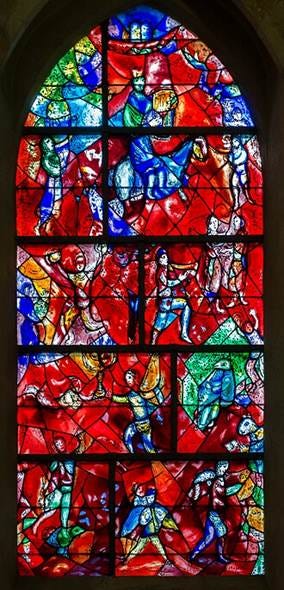
It’s not just musicians, however, who are inspired by Psalm 150. Marc Chagall was a Jewish artist famous for his colour-filled, modernist artwork and, particularly in his later years, his stained glass. This stained glass from Chichester Cathedral is entitled ‘Let everything that hath breath praise the Lord’. While Chagall is often associated with more of a blue hue found in some of his most famous works, for this project, he used a bright, vibrant red to portray the praise and effusion of this psalm. The window has images of all the musical instruments that Psalm 150 makes reference to. And, importantly, this was not created simply as a piece of artwork, but a piece of art that was meant to help guide people toward praise of God. Reading Psalm 150 alongside Chagall’s window helps us remember the celebration that God is worthy of, and the joy it is to participate in that celebration.
The other thing that strikes me about the Chagall window is the communal nature of it—while you do have individual characters off playing their own individual instruments, there is also a sense of unity to the image. Partially, it’s the unity of the red background holding them together. But you also have figures dancing and playing instruments together, facing each other, leading each other along. This is not a solo exercise for them. This reminds me that praise is both individual and communal. We, as individuals, are called to praise God. But we, as a community, in our churches, as a whole communion of saints, are to praise God together. We help each other to praise. And we don’t do that by all being the same. As Augustine writes of the various different instruments in this psalm, ‘they sound not each separately, but sound together in most harmonious diversity, just as they are arranged in a musical instrument. For even then the saints of God will have their differences, accordant, not discordant, that is, agreeing, not disagreeing, just as sweetest harmony arises from sounds differing indeed, but not opposed to one another’ (Exposition on Psalm 150, 5). Our differences shouldn’t be squashed out, nor should they be pitted against each other, they should be played together in beautiful harmony.
It’s not always easy to praise, though. And, honestly, it can feel quite grating to be told to praise when you really, really aren’t feeling like it. And this is where having the rhythm of the psalms in our lives can help us. We regularly sing the doxology to our daughter: ‘praise God from whom all blessings flow, praise him all creatures here below, praise him above ye heavenly hosts, praise Father, Son, and Holy Ghost’. One week, as happens with toddlers, she picked up a nasty virus and passed it on to the rest of the family. When she was little and struggling to sleep she used to ask us to ‘pray and sing’ to help her get back to sleep. While battling fevers and coughs ourselves, we spent an evening doing a lot of praying and singing, and pleading and crying together. What I won’t be able to forget is hearing her little voice asking, ‘Praise God, Mommy, Praise God’. I did not feel like praising God much in those early, exhausting hours. But my daughter did, and she helped me praise Him too in what, in the throes of sleep deprivation, felt like a very low moment.
Praise doesn’t always come naturally to us. We need to be taught to praise. My daughter wouldn’t have known that song had we not spent night after night singing it to her. It wouldn’t have become second nature for her to ask for it if it hadn’t been built into the rhythm of her little life. And praise won’t necessarily look identical for each of us. Some of us might praise God in music, some of us will do so in words. Some of us may do so with raised hands, some with tears, some quietly, some loudly. The diversity of instruments relays the fact that with whatever is at your disposal, use it to praise the Lord. With all that you are, with every breath, praise the Lord.
In describing the purpose of the Psalms, Eugene Peterson wrote, ‘They are not provided to teach us about God but to train us in responding to him.’ The Psalter is our exercise book. And as we repeat the psalms week after week, year after year, Peterson writes, ‘We will expect to find the experience of being human before God, exposed and sharpened’ (Answering God, 12). I love that line ‘the experience of being human before God’. Human with all our limits and worries and frustrations. As we read the psalms alongside our circumstances, they sharpen us, they help us respond well whatever the circumstances. Psalm 150 has seen me through some very difficult times. The Psalter as a whole has helped me process the highs and lows of life. Hearing God’s voice minister to me through the psalms has strengthened me, has comforted me, and has challenged me where I needed challenged. As I’ve sat with Psalm 150 this week I’ve heard that same little voice from the early hours saying ‘Praise God, Mommy, Praise God’. And I can honestly say along with Psalm 150, even if some days it’s with tears and weariness, ‘Hallelujah, Praise the Lord’.
[As a bonus, I love this version of Psalm 150 by Poor Bishop Hooper:]